Are You Stuck in Survival Mode? A Trauma-Informed Guide to Finding Safety in San Antonio & Boerne

There comes a point for many people where life starts to feel heavy in a way that’s hard to name.
On the outside, things may look fine. You’re showing up, you’re functioning, and you’re doing what needs to be done. But internally, something feels off. Like you’re always bracing; always pushing, or, at times, completely shutting down.
In trauma-informed work, we often understand this as the nervous system operating in survival mode.
At Whole Life Healing, this isn’t seen as something being “wrong” with you. It’s your body doing exactly what it learned to do to get through overwhelming or stressful experiences.
These patterns are adaptive, and they make sense in context.
Moving past the “why” and into what your system has learned about safety over time, this guide breaks down how to begin finding safety again when survival mode has become the default.
How Survival Mode Shows Up in Everyday Life
Survival mode doesn’t always feel like an emergency on the outside. In fact, it often hides inside high-functioning lives.
I see this frequently in clients who are responsible, capable, and outwardly successful. They’re the ones holding everything together. Saying yes when they’re already overwhelmed. Staying busy because slowing down feels uncomfortable, or even unsafe.
For some, it looks like overgiving or people-pleasing. For others, it shows up as constant productivity or emotional avoidance. They’re different presentations, but often with the same underlying drive: stay regulated, stay safe, and don’t feel too much.
And then there’s the other side.
Instead of pushing forward, the system begins to shut down: motivation drops, focus becomes difficult, and there’s a sense of disconnection, like you’re there, but not fully there.
Both ends of this spectrum are part of the same system trying to protect you.
In trauma work, we often describe these responses as fight, flight, freeze, and fawn. These responses don’t represent personality traits, but rather, learned patterns. Your nervous system choosing the best available option based on past experience.
Understanding Your Window of Tolerance
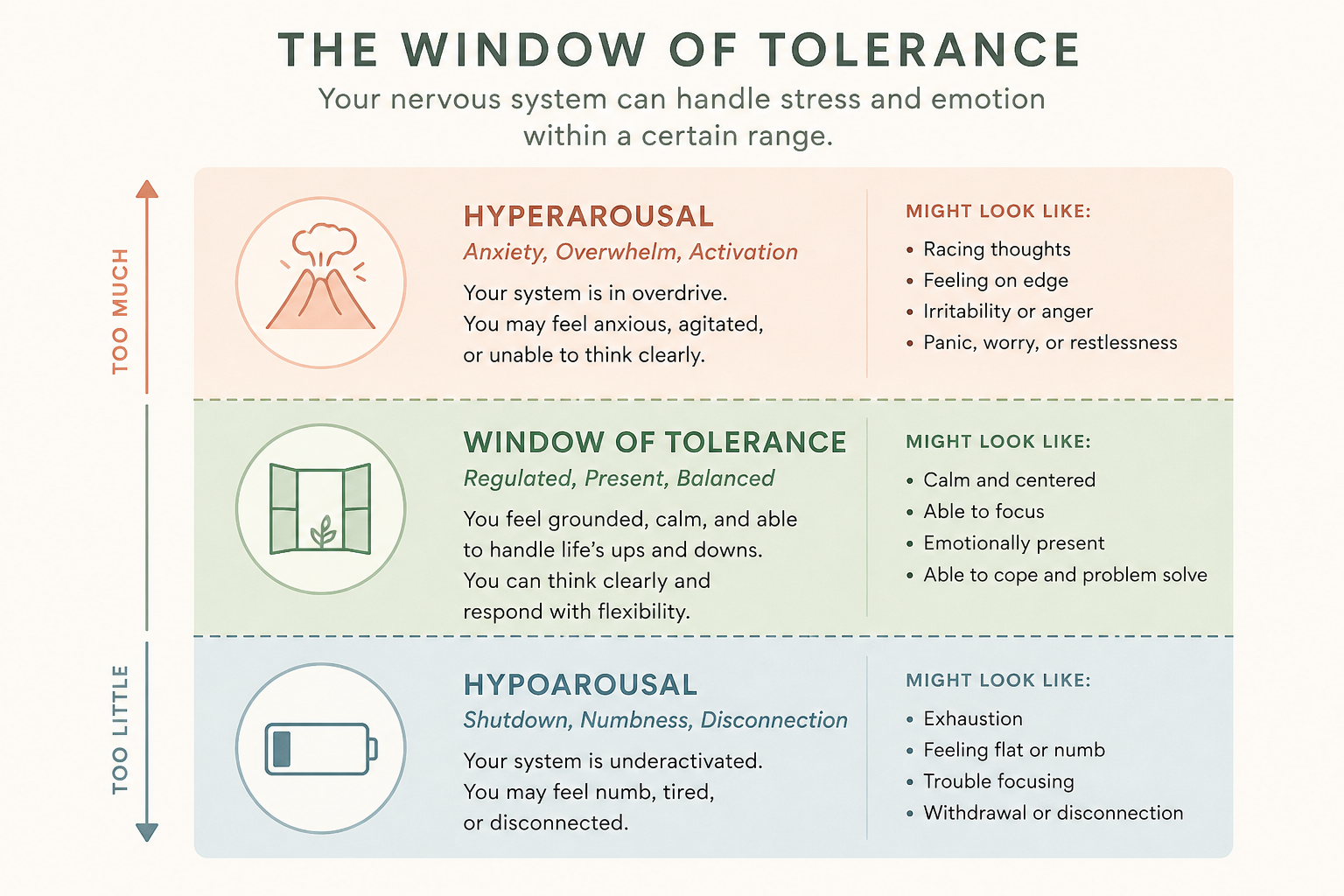
One of the most helpful frameworks I use with clients is the window of tolerance.
This is your nervous system’s capacity to handle stress, emotion, and daily life while still feeling grounded and present.
When you’re within that window, things tend to feel manageable. You can think clearly. You can respond instead of react, and there’s a sense of flexibility.
When the window narrows, the system shifts.
Some people move into a state of activation: anxiety increases, thoughts race, and the body feels tense, alert, on edge. Even in safe environments, there can be a sense that something isn’t quite right.
Others move in the opposite direction: energy drops, everything feels heavier, and it becomes harder to initiate tasks or stay connected. This is where people often describe feeling stuck or numb.
Many people move between these states over time. I often hear clients describe “hitting a wall” after years of pushing through. That moment doesn’t mean you’ve failed, it actually means your nervous system has reached its limit.
When Control Becomes a Form of Safety
One pattern I see often, especially in high-functioning individuals, is over-functioning.
Taking on more than your share, anticipating problems before they happen, and staying organized, prepared, and in control.
On the surface, this can look like strength. And in many ways, it is.
But underneath, there’s often a deeper need: creating safety through control.
If your earlier experiences involved unpredictability or instability, control can feel like the safest option available. The challenge is that control is fragile. When something unexpected happens, the nervous system can respond quickly and intensely.
This is where burnout tends to develop. Periods of sustained effort followed by exhaustion, shutdown, and eventually starting the cycle again.
In trauma-informed care, we don’t approach this by simply telling someone to “do less.” That rarely works. Instead, we focus on slowly building the capacity to tolerate uncertainty, while creating boundaries that feel sustainable.
Why Safety Can Feel Uncomfortable at First

One of the most important things to understand is that safety doesn’t always feel the way people expect it to.
If you’ve spent years in survival mode, calm can feel unfamiliar; even unsettling.
I’ve had many clients tell me that when things finally slow down, they feel restless, agitated, or like they should be doing something, even when nothing is wrong.
If you feel this, this doesn’t mean it's a setback, it’s your nervous system adjusting.
When the body has been conditioned to expect stress, it doesn’t immediately trust calm. It may even start searching for something to fix or anticipate.
There can also be grief in this process. Grief for how long you’ve been carrying this, for unmet needs, or for the amount of effort it took just to get through.
That grief is not a detour from healing. It’s an important part of it.
What Begins to Shift Over Time
As safety starts to develop, changes tend to be gradual but noticeable.
Clients often describe feeling more clear-headed, less physically tense, and more steady in their emotional responses. There’s a growing ability to move through stress without becoming overwhelmed or shutting down.
Relationships can feel different too; less reactive, and more connected.
Safety isn’t the absence of stress, it’s the ability to stay with yourself while moving through it.
Moving from Survival Mode Toward Safety
This shift happens through small, consistent experiences that help the nervous system learn something new.
Part of the work is simply recognizing that your current patterns have a function; they helped you at some point. When that’s acknowledged, there’s often less self-criticism and more room for change.
From there, we begin to build safety in manageable ways. That might look like creating moments of predictability in your day. Allowing brief periods of rest without needing to earn them. Or engaging in simple, grounding practices that bring your attention back to the present.
Boundaries also become an important part of this process. Not as a rigid rule, but as a way of protecting your energy and capacity.
And for many people, having support matters. Trauma-informed therapy, including approaches like EMDR and somatic work, can help process the deeper patterns that keep the nervous system stuck in survival.
A Different Way Forward
If you find yourself stuck in survival mode, that is not a personal failure, it’s a reflection of what your system needed to do to get through.
The purpose of finding safety is not to eliminate these responses entirely, but to expand your capacity so they’re no longer your only option.
As that capacity grows, life can begin to feel different; less like something you’re constantly managing or enduring, and more like something you can actually be present for.
While that shift is often gradual, it’s incredibly meaningful.
And it’s possible.
If you’re ready to move from survival mode toward a greater sense of safety, we’re here to help guide you.